One of the core prinicples of agroecology is fair distribution. It is not enough to just grow more food, but that food must be distributed to everyone who needs it. Profiteering on mass produced grain generates profits for the middlemen, but the food is often taken away from the countries that need it. We live within a highly competitive economy. Margins are squeezed and the produce sold to the highest bidder, on the international markets. There is no incentive for businessmen to act responsibly, in fact the opposite is true. There is every incentive to act irresponsibly, to ignore social values and to ignore the hungry. One little discussed reason for this pressure on business is the threat of bankruptcy. Where does this threat of bankrupcy come from? Interest bearing money creation means bankruptcy is ever present for enterprises around the world.
What is interest bering money creation? Consider a brand new economy: the central bank creates £10 in year 1 and loans it to a group of businesses. £2 is charged in interest in the first year, not created, just charged, so the businesses owe £12 in year 2. Where does that extra £2 come from? There is only £10 in circulation. The bank can create more money and issue more loans, but eventually, when the economy slows down, at least one of the businesses will go bust because there is not enough money in circulation to meet the debt repayments. This is reflected in thousands of insolvencies in Britain each year. Some call it creative destruction, sorting the wheat from the chaff, but in reality it is feeding a dog eat dog mentality. Few directors would voluntarily pursue an ecological or ethical strategy under these conditions.
In contrast to positive interest bearing money creation, negative interest offers a way out of this complex. The banks create £10 in year one, and only demand £10, or less, in year two. “Doesn’t that mean we’d pay to keep savings, and receive money for being in debt?” asked a friend. In theory, yes. But there would be ways to mitigate the effects of negative interest such as savings trusts that stood outside the interest environment and zero rated loans. Savings trusts for retirement, buying a house, school fees, a car, a computer could all sit outside the negative interest environment. In Japan in 2016, the Bank of Japan introduced a rate of -0.1% in an attempt to ease deflation. The banks offered a three teir savings structure to protect the majority of savings: +0.1%, 0% and -0.1%, with only a fraction paying the negative rate on their savings.
A negative interest rate has the potential to improve the macroeconomic conditions of the economy, as well as changing the public’s attitude towards cash. Cash is not to be hoarded but reinvested back into the economy, either as loans, spending on goods, or gifting. On a macroeconomic level, money is created at a negative interest rate, or a zero rate, creating an situation where low return industries such as food and farming suddenly appear much more appealing.
In a developed country, where most of our daily needs are met, economic growth will be necessarily slow. Areas of growth will be sporadic rather than the norm with innovations improving the basics of life rather than introducing entirely new ways of being. Growth comes in the form of improved efficiencies, such as AI tools to get better search results, quantum computing to process large volumes of data more quickly and robotics to streamline supply chains. We await the next big thing such as flying cars, space travel and clean energy to power our next growth spurt, but in the mean time it makes sense to consolidate what we have. Agroecology offers an opportunity for the quality of our food to be improved. Organic food is a substitute product for conventional food and while it does not offer the obvious returns of IT investment, it does improve the quality of life of the people who eat it.
In a low growth environment, which is what most developed countries are currently facing, areas of low growth (not necessarily zero growth) should be embraced. Qualitative benefits such as improved public health and natural capital like soil and water quality should be accounted for in investment proposals. If we factor in the opportunity costs of organic food, produced agroecologically, conventional food has a poor return on investment.
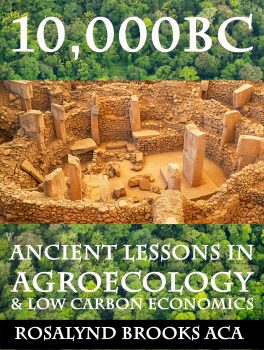
Negative interest is a counterintuitive idea that is based on recreating our cultural relationship with money. Eisenstein discusses it in more detail in his book Sacred Economics. I included an introduction to it in 10,000BC because hoarding large amounts of money gained during high growth periods is creating significant inequality. Hundreds of thousands of people now rely on food banks because even the price of food is too much for them. Our system of positive interest bearing money creation fuels our addiction to high growth economics, which increases inequality and ignores low growth areas such as agroecology. Negative interest could increase spending, particularly in low growth areas that are being ignored in a positive interest environment. By spending time in a negative interest environment, zero rated loans also take some of the pressure off company directors, because the threat of bankruptcy is reduced. Social aims such as reducing hunger become more viable.
Read more about negative interest in chapter 8 of 10,000BC, On The Quest For Equality, here.
 10,000BC